
ICAI AI Course for CAs: AICA Level 1 and Level 2 Syllabus, Fees and Review (2026)
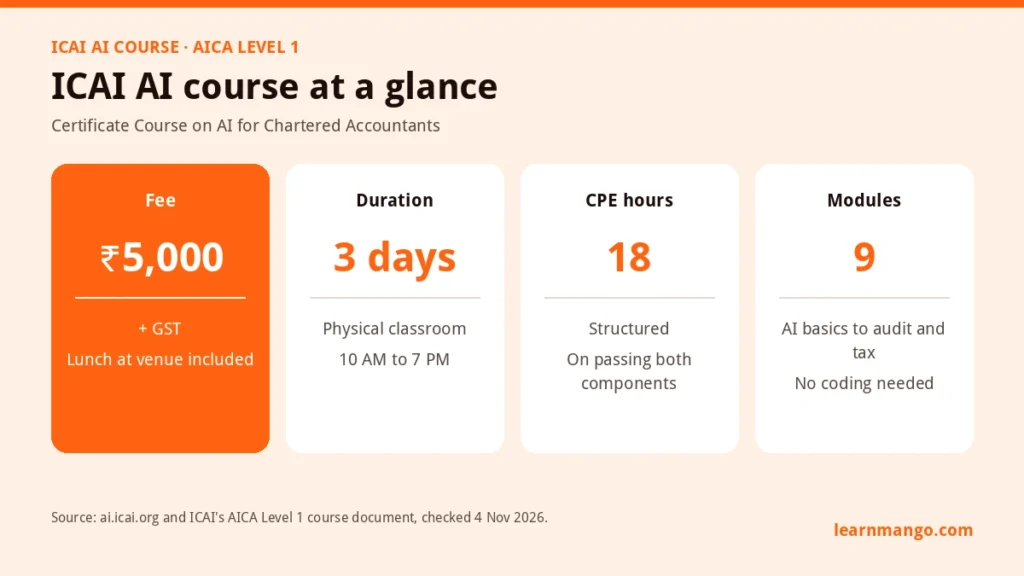
The ICAI AI course is the Certificate Course on AI for Chartered Accountants (AICA), run by the AI Committee of the Institute of Chartered Accountants of India. It comes in two levels: AICA Level 1, a three-day classroom course costing ₹5,000 plus GST, and AICA Level 2, a longer hybrid course costing ₹10,000 plus GST. Both are taught at ICAI branches and centres of excellence across India, carry structured CPE hours, and are designed to help CAs use AI in accounting, audit, tax and finance.
This guide covers the full ICAI AI course syllabus, fees, batch dates, assessment rules and certificate, explains how Level 1 and Level 2 differ, and gives our view on who should take it.
Quick answer: AICA Level 1 costs ₹5,000 + GST, runs for three days in a physical classroom at an ICAI branch, covers nine modules from AI basics to AI in auditing and tax, and earns 18 structured CPE hours. AICA Level 2 costs ₹10,000 + GST and combines online and classroom days. Batches are listed on ICAI’s AI portal, ai.icai.org.
Fees, modules and batch details were checked on ICAI’s official AI portal and course documents on 4 November 2026. Confirm the current batch and fee on ai.icai.org before you register.
Table of Contents
What Is the ICAI AI Course?
The ICAI AI course is a professional certificate programme for Chartered Accountants, run by ICAI’s AI Committee through its regional councils and branches. The ICAI AI portal lists two certificate courses under the name Certificate Course on AI for CA’s: AICA Level-1 and AICA Level-2. ICAI’s Level 1 course document also says the institute plans a third level, AICA Level 3.
The course is practical rather than academic. It teaches CAs what AI and machine learning are, then shows how they apply to the work CAs actually do: analysing financial data, reading contracts and documents with natural language processing, running AI-assisted audit procedures and supporting tax work. It is not a degree and does not require any coding background.
Scale is significant. In February 2025, Careers360, reporting PTI, quoted ICAI as saying 12,000 chartered accountants had already been trained in AI and training for more than 15,000 more was in the pipeline.
ICAI AI Course at a Glance
| Detail | AICA Level 1 | AICA Level 2 |
|---|---|---|
| Run by | AI Committee of ICAI | AI Committee of ICAI |
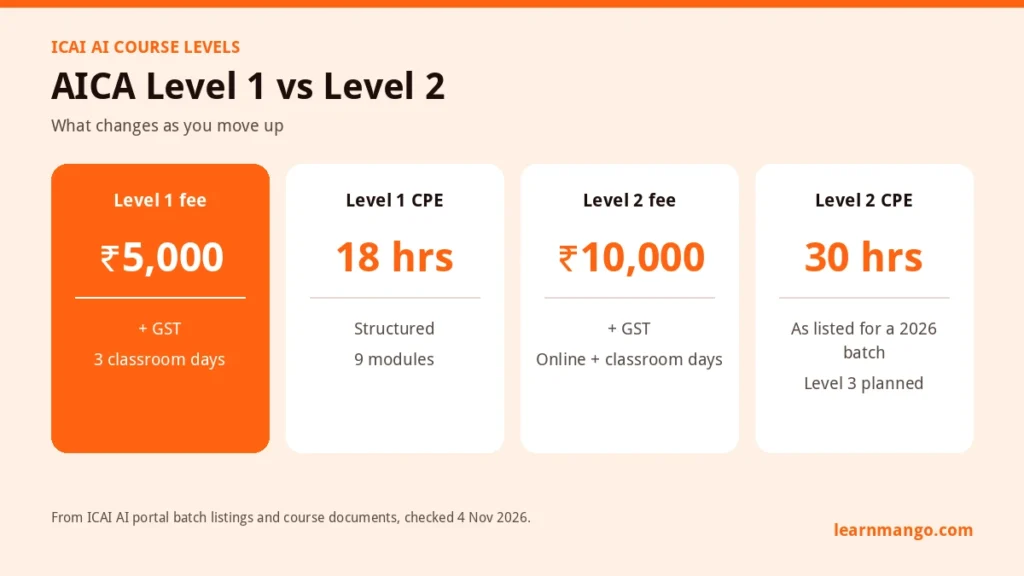
| Fee | ₹5,000 + GST | ₹10,000 + GST |
| Format | 3 days, physical classroom at an ICAI branch | Online days plus classroom days (for example, 2 online + 3 offline) |
| CPE hours | 18 (structured) | 30 (as listed for a 2026 batch) |
| Participants | Chartered Accountants | Chartered Accountants who have done Level 1 (check batch terms) |
| Certificate | AI for Chartered Accountants (AICA) Level 1 | AICA Level 2 |
| Current batches | Listed from 2 November to 3 December 2026 | Listed from 21 November 2026 into February 2027 |
ICAI AI Course Fees
The ICAI AI course fees are published on every batch card on the ICAI AI portal:
- AICA Level 1: ₹5,000 + GST per participant. ICAI’s course document notes that lunch is provided by the host branch at the venue and is included in the fee.
- AICA Level 2: ₹10,000 + GST per participant.
Accommodation and travel are at the participant’s own cost, according to ICAI’s Level 1 guideline. For a three-day course costing ₹5,000 plus GST with 18 CPE hours, the ICAI AI course is among the most affordable structured AI programmes available to Indian professionals.
ICAI AI Course Syllabus: AICA Level 1 Modules
The AICA Level 1 syllabus has nine modules spread over three days, as set out in ICAI’s Level 1 course module and structure document. Classes run from 10 AM to 7 PM.
| Day | Module | Duration |
|---|---|---|
| Day 1 | Module 1: Overview of AI & Basic Concepts | 2 hours |
| Day 1 | Module 2: Introduction to AI | 2 hours |
| Day 1 | Module 3: Machine Learning Basics | 2 hours |
| Day 2 | Module 4: Dx for Accounting | 2 hours |
| Day 2 | Module 5: Natural Language Processing (NLP) in Finance & Audit | 2 hours |
| Day 2 | Module 6: AI and ML Applications in Finance | 2 hours |
| Day 3 | Module 7: Implementing AI Projects in Finance & Audit | 2 hours |
| Day 3 | Module 8: AI in Auditing & Tax | 1 hour |
| Day 3 | Module 9: Ethical Considerations and Future Trends | 2 hours |
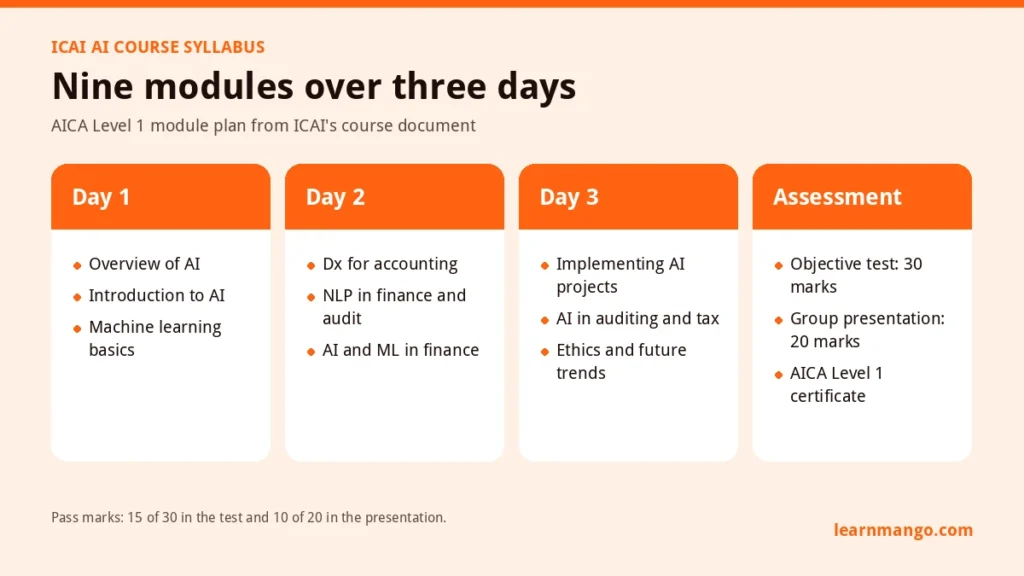
The flow is sensible for working CAs: day one builds vocabulary and basic machine learning intuition, day two applies AI to accounting data and documents, and day three turns to implementing projects, audit and tax use cases, and the ethical questions CAs must weigh when they rely on AI output.
Prerequisites and what to bring
ICAI lists the prerequisites as basic computer and Microsoft Office knowledge, a working understanding of finance, audit and statistics, and problem-solving skills. Participants must bring their own laptop, with at least Windows 11, 8 GB of RAM and an i3 processor. No programming experience is required.
Assessment and Certificate
AICA Level 1 is assessed in two parts, according to ICAI’s course document:
| Component | Marks | Pass mark |
|---|---|---|
| Module A: objective online test | 30 | 15 |
| Module B: group project presentation (5 minutes per team) | 20 | 10 |
The course also uses quizzes and assignments during the three days. Participants who clear both components receive the AI for Chartered Accountants (AICA) Level 1 certificate and 18 structured CPE hours.
AICA Level 2: What Changes
AICA Level 2 is the next step for CAs who have completed Level 1. It is longer and uses a hybrid format: a Jaipur centre-of-excellence batch, for example, is listed with two online days on 5 and 6 December 2026 and three classroom days from 8 to 10 December 2026. A 2026 Level 2 batch hosted by ICAI’s Eastern India Regional Council lists 30 CPE hours. The fee is ₹10,000 plus GST.
ICAI’s Level 2 course document is linked from the portal; check it for the module list, eligibility and assessment rules before you register, as these were not shown on the batch listing itself.
How to Register for the ICAI AI Course
- Visit the ICAI AI portal at ai.icai.org.
- Open the Certificate Course menu and choose AICA Level-1 or AICA Level-2.
- Browse the batch cards by city and dates, and check whether registration is still open for your chosen batch.
- Register and pay the fee (₹5,000 + GST for Level 1, ₹10,000 + GST for Level 2).
- Prepare your laptop to the stated specification and attend all days at the venue.
For questions, ICAI’s Level 1 guideline lists the helpline email ai@icai.in.
Upcoming batches
As of 4 November 2026, the portal lists AICA Level 1 batches between 2 November and 3 December 2026 in cities including Tirupati, Bengaluru, Chengalpattu, Chandigarh, Pune, Jaipur, Kolkata, Mumbai and Chennai, and Level 2 batches from 21 November 2026 into February 2027. Popular batches can close quickly, so register early.
ICAI AI Course for CA Students
Many CA students search for an ICAI AI course for students. The AICA course documents list the participants as Chartered Accountants, so AICA is designed for qualified members. CA students should check the ICAI Board of Studies announcements for any AI content within their own training, and can build AI basics in the meantime through free options such as the government’s YUVA AI for All course or NPTEL. Our guide to free AI courses with certificates lists these options.
How CAs Can Use AI in Practice
The course modules point to the areas where AI already changes a CA’s work:
- Audit: analysing whole populations of transactions rather than samples, flagging unusual entries for review.
- Documents: using natural language processing to read and summarise contracts, notices and financial statements.
- Tax: speeding up research and first drafts, with the CA checking every conclusion against the law.
- Finance and advisory: forecasting, scenario analysis and dashboards built with AI assistance.
- Ethics and judgement: knowing when AI output cannot be relied on, and documenting how it was used.
The last point matters most. AI can draft and analyse, but professional responsibility stays with the CA, which is why the course closes with ethical considerations.
How to Prepare for AICA Level 1
Three days pass quickly, so a little preparation helps you get far more from the ICAI AI course. These are our suggestions, not ICAI requirements.
- Set up your laptop in advance. Check that it meets ICAI’s stated minimum (Windows 11, 8 GB RAM, i3 processor), update it, and make sure you can install software and connect to Wi-Fi at the venue.
- Refresh basic statistics. Averages, distributions, correlation and sampling come up when machine learning is introduced, and ICAI lists statistics among the prerequisites.
- Try an AI assistant on a real task. Before day one, use a general AI assistant to summarise a public annual report or draft a simple audit checklist, then note where it was wrong. You will follow the classroom discussion of limitations much more easily.
- Bring a use case from your practice. Think of one repetitive task in your work, such as bank reconciliations, ledger scrutiny or notice replies, and use the group project to explore how AI could help.
- Plan your CPE. The 18 structured hours are credited on passing both assessment components, so attend every session and take the test seriously.
Client Confidentiality When Using AI
For CAs, the biggest practical risk with AI tools is not technical but professional: confidential client data. Uploading ledgers, tax returns or engagement files to a public AI service can breach client confidentiality and firm policy. Before using any AI tool on client work, check where the data goes, whether it is stored or used for training, and whether your firm has an approved tool. Anonymise data wherever possible, keep a record of how AI contributed to a conclusion, and review every output yourself. The ICAI AI course’s final module on ethical considerations is the right place to raise these questions with the faculty.
What to Do After the ICAI AI Course
AICA Level 1 gives you a structured start. Where you go next depends on how deeply you want to work with AI:
| Goal | Next step | Cost |
|---|---|---|
| Go deeper within the profession | AICA Level 2 (and Level 3 when launched) | ₹10,000 + GST for Level 2 |
| Build hands-on data and ML skills | An online certificate such as IIT Patna’s AI & ML programme | ₹54,000 + GST, 8 months |
| Learn the theory from IIT faculty | NPTEL AI and machine learning courses | Free to learn; ₹1,000 exam for a certificate |
| Build general AI literacy for your team | YUVA AI for All, the free national course | Free, about 4.5 hours |
Our reviews of the IIT Patna AI course and our guide to free AI courses cover these options in detail. If you advise clients on technology adoption, building a small internal AI playbook after the course, covering approved tools, data rules and review steps, is often the most valuable outcome.
ICAI AI course vs general AI courses
The main advantage of the ICAI AI course over general AI courses is relevance. A generic machine learning course spends most of its time on programming and model building, while AICA spends its three days on accounting data, audit procedures, tax work and professional ethics. General courses go deeper on the technology; AICA goes deeper on what the technology means for a CA’s practice. Many CAs will benefit from both, starting with AICA.
ICAI AI Course Review: Is It Worth It?
This is our assessment based on ICAI’s published course documents, not on attending a batch.
What works well:
- Low cost: ₹5,000 plus GST for three days of instruction and 18 CPE hours.
- Content tailored to accounting, audit, tax and finance rather than generic AI.
- Classroom delivery with a group project, so you practise with peers.
- A clear path to Level 2 and, according to ICAI, a planned Level 3.
What to watch:
- Three days is an introduction; real fluency needs practice afterwards on your own work.
- Batches are city-based and in person for Level 1, so availability depends on your region.
- Older news coverage described the programme as a one-year certificate, while current ICAI documents describe a three-day Level 1, so rely on the course documents for format.
For most practising CAs, AICA Level 1 is worth taking: it is inexpensive, counts towards CPE and gives a structured, profession-specific start. Pair it with regular practice and, if you want deeper skills, a longer AI or data course afterwards. Our guide to machine learning and AI courses compares longer options.
Frequently Asked Questions
What is the ICAI AI course?
The ICAI AI course is the Certificate Course on AI for Chartered Accountants (AICA), run by the AI Committee of ICAI. It has two levels: a three-day classroom Level 1 and a longer hybrid Level 2, covering AI and machine learning applied to accounting, audit, tax and finance.
What is the ICAI AI course fee?
AICA Level 1 costs ₹5,000 plus GST and AICA Level 2 costs ₹10,000 plus GST, as listed on ICAI’s AI portal. Lunch at the venue is included for Level 1; travel and accommodation are extra.
How long is the ICAI AI course Level 1?
AICA Level 1 runs for three days in a physical classroom at an ICAI branch, from 10 AM to 7 PM, with nine modules and two assessments. It carries 18 structured CPE hours.
What is the ICAI AI course Level 1 syllabus?
The nine modules are: Overview of AI and Basic Concepts, Introduction to AI, Machine Learning Basics, Dx for Accounting, NLP in Finance and Audit, AI and ML Applications in Finance, Implementing AI Projects in Finance and Audit, AI in Auditing and Tax, and Ethical Considerations and Future Trends.
Is the ICAI AI course for CA students?
The AICA course documents list participants as Chartered Accountants, so it is designed for qualified members. CA students should check ICAI Board of Studies announcements and can start with free AI courses in the meantime.
How do I register for the ICAI AI course?
Go to ai.icai.org, open the Certificate Course menu, choose AICA Level-1 or Level-2, pick a batch in your city and register by paying the fee. Bring a laptop meeting ICAI’s stated specification.
How many CPE hours does the ICAI AI course give?
AICA Level 1 carries 18 structured CPE hours. A 2026 AICA Level 2 batch hosted by ICAI’s Eastern India Regional Council lists 30 CPE hours.
How is the ICAI AI course assessed?
Level 1 has an objective online test worth 30 marks (pass mark 15) and a five-minute group project presentation worth 20 marks (pass mark 10), alongside quizzes and assignments.
Do I need coding knowledge for the ICAI AI course?
No. ICAI lists basic computer and Microsoft Office knowledge, an understanding of finance, audit and statistics, and problem-solving skills as the prerequisites. No programming background is required.
Is the ICAI AI course worth it?
For most practising CAs, yes. Level 1 costs ₹5,000 plus GST, earns 18 CPE hours and focuses on accounting, audit and tax use cases. It is an introduction, so follow it with practice on your own work.
Key Takeaways
- The ICAI AI course is AICA, the Certificate Course on AI for Chartered Accountants, run by ICAI’s AI Committee.
- Level 1 costs ₹5,000 plus GST for three classroom days and 18 CPE hours; Level 2 costs ₹10,000 plus GST.
- The nine Level 1 modules move from AI basics to NLP, audit, tax and ethics, with no coding required.
- Batches are listed by city on ai.icai.org, and a Level 3 is planned.
- It is designed for qualified CAs; students can start with free AI courses.
Fees, modules and batch details were checked against ICAI’s AI portal and course documents on 4 November 2026. Learnmango has no commercial relationship with ICAI.