
ISRO Free Online Courses With Certificate 2026: IIRS, START and YUVIKA Explained
ISRO’s free online courses are run mainly by the Indian Institute of Remote Sensing (IIRS), Dehradun, through its outreach and e-learning programme. IIRS states that its online courses are “offered completely free of cost for students”, and participants who attend at least 70% of the online classes have been awarded a certificate of participation. ISRO also runs START, a free online space science training for college students, and YUVIKA, a residential programme for school students.
This guide explains every ISRO free course and programme an Indian student can join, who each one is for, how registration works, what the certificate requires, and how to avoid fake “ISRO course” sellers.
Quick answer: The main ISRO free courses are IIRS–ISRO online courses on remote sensing, GIS and space technology (free, certificate with 70% attendance), and START (Space science and Technology AwaReness Training), a free online programme of about three weeks for postgraduate and final-year undergraduate students. School students who have passed Class 9 can apply for YUVIKA, a two-week residential programme at ISRO centres.
Facts on this page were checked on isro.gov.in and iirs.gov.in on 5 November 2026. ISRO announces new courses through official notices, so dates change every year.
Table of Contents
ISRO Free Courses and Programmes at a Glance
| Programme | Run by | Mode | Who can join | Cost |
|---|---|---|---|---|
| IIRS–ISRO online courses (outreach programme) | IIRS, Dehradun | Online, live classes | Students, faculty and professionals, via nodal centres or individually | Free |
| START | ISRO, with IIRS | Online lectures, about 3 weeks | PG and final-year UG students of physical sciences and technology | Free registration through nodal centres or individually |
| YUVIKA (Young Scientist Programme) | ISRO | Two-week residential, at ISRO centres | Students who have passed Class 9 | Selection-based |
| Antriksh Jigyasa portal | ISRO, through IIRS | Online STEM portal | Students and teachers | Free to explore |
IIRS–ISRO Online Courses: Free Remote Sensing and Space Courses
The Indian Institute of Remote Sensing in Dehradun is ISRO’s training and education unit for remote sensing, geoinformatics and space technology. Through its outreach programme, IIRS runs short online courses on topics such as remote sensing, GIS, geological applications and space technology.
Are ISRO online courses really free?
Yes. The IIRS outreach page carries a clear notice: “IIRS–ISRO online courses are offered completely free of cost for students. No course fee is charged.” It also warns students “not to make any payment for IIRS–ISRO online courses to any Nodal Centre, Course Coordinator, or to any individual or organization.”
If anyone asks you to pay for an ISRO free course, treat it as a red flag and register only through the official IIRS or ISRO websites.
Examples of past IIRS online courses
IIRS lists each course with an ID number on its outreach page. Recent examples include:
| Course | Dates |
|---|---|
| Overview of Space Technology (Course ID 148) | 9–20 September 2024 |
| Advances in Remote Sensing Techniques for Geological Applications | 11–15 March 2024 |
| Course on Aditya-L1 | 18 March 2024 |
| Paleochannel Studies (in Hindi) | April 2024 |
These examples show the range: from a broad two-week overview of space technology to a one-day course on India’s solar mission, and even courses taught in Hindi.
ISRO free course certificate rules
For IIRS online courses, the certificate depends on attendance. A 2023 course notice states that “all participants will be awarded a certificate of participation based on 70% attendance during the online classes.” Some courses also publish examination information, so read each course’s notice before you start.
How to register for IIRS online courses
IIRS publishes separate guidelines for participants joining through a nodal centre (usually a college or university that hosts the course for its students) and for individual participants. Each course notice links to an online registration form, and START registration in 2026 used the IIRS e-learning registration page at elearning.iirs.gov.in.
- Check your college first. Many colleges register as nodal centres, which makes it easy to join with classmates.
- Read the course notice on the IIRS outreach page for dates, eligibility and certificate rules.
- Register on the official form linked from the notice; do not use third-party links.
- Attend the live sessions and keep your attendance above 70% for the certificate.
ISRO START: Free Online Space Science Training
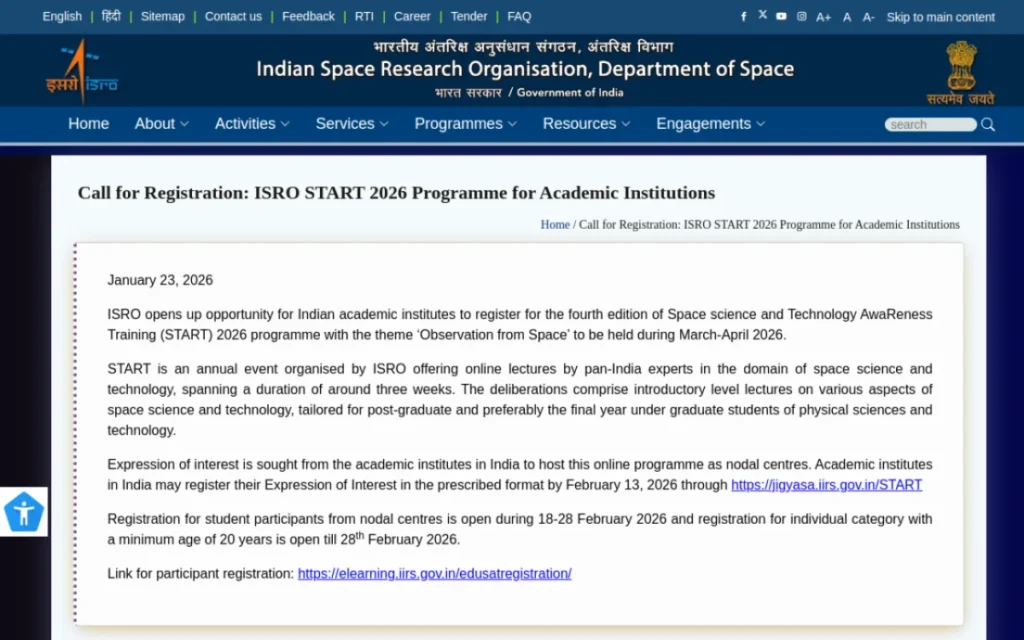
START stands for Space science and Technology AwaReness Training. ISRO describes it as “an annual event organised by ISRO offering online lectures by pan-India experts” in space science and technology, “spanning a duration of around three weeks”.
Key facts from ISRO’s START 2026 announcement, dated 23 January 2026:
- Edition and theme: the fourth edition, with the theme “Observation from Space”.
- When: March–April 2026.
- Who it is for: postgraduate and, preferably, final-year undergraduate students of physical sciences and technology.
- Nodal centres: academic institutions registered their interest by 13 February 2026 through the Jigyasa portal.
- Student registration: through nodal centres from 18 to 28 February 2026, or as an individual with a minimum age of 20 years until 28 February 2026.
If the pattern holds, the next START call is likely to appear early in the year, so watch isro.gov.in from January.
YUVIKA: ISRO’s Young Scientist Programme for School Students
YUVIKA (YUva VIgyani KAryakram) is not an online course, but it is the ISRO programme school students ask about most. ISRO calls it “a two-week residential programme for ninth class passed out school students of India”.
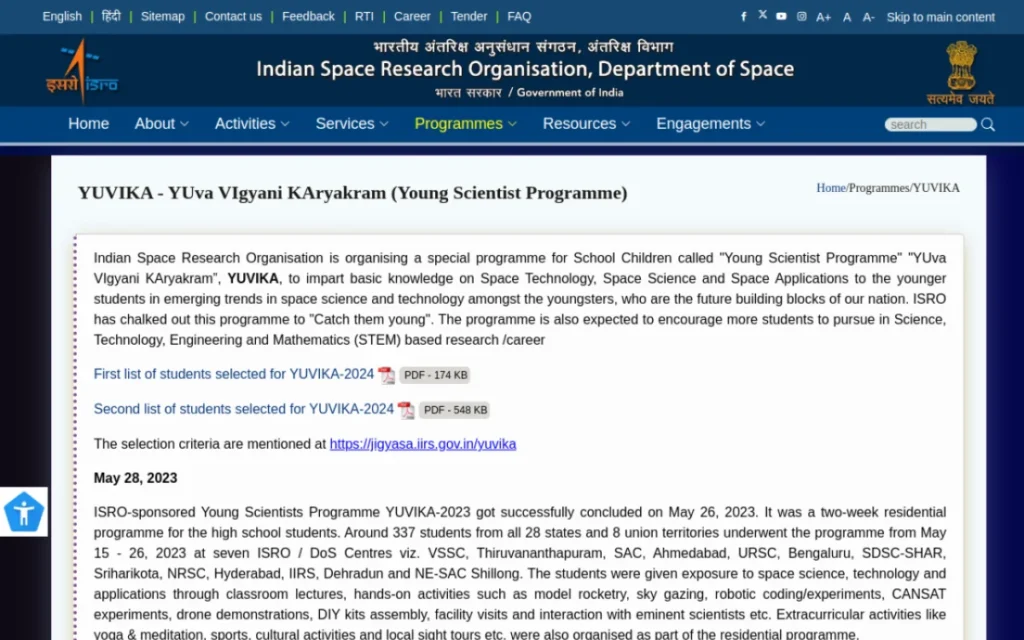
According to ISRO’s YUVIKA 2026 page:
- YUVIKA 2026, the sixth edition, ran from 11 to 22 May 2026.
- 1,06,530 students registered, and 456 were selected from 28 states and 8 union territories.
- It was held at nine ISRO centres, including two new hosts, IPRC Mahendragiri and RRSC Jodhpur.
- Across its first five editions, 1,320 students had been trained.
- Activities included talks with senior scientists and Gaganyaatris, a live RH200 rocket launch, Chandrayaan-3 DIY kit assembly and model rocket launches.
With roughly 1 in 230 applicants selected in 2026, YUVIKA is highly competitive. Selection criteria are published on the Jigyasa portal.
Antriksh Jigyasa: ISRO’s STEM Learning Portal
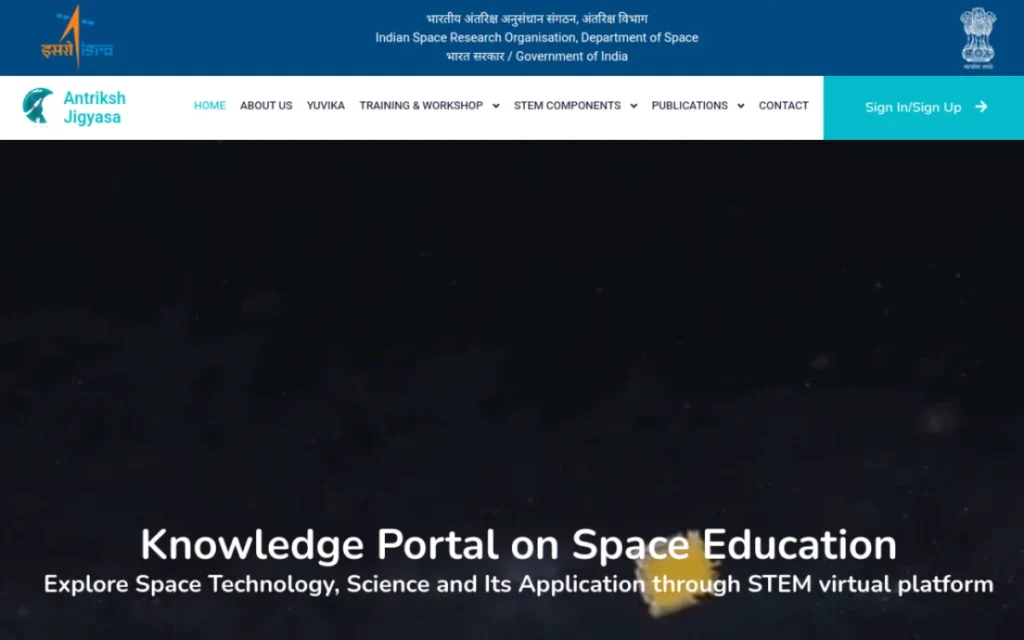
Antriksh Jigyasa is ISRO’s knowledge portal on space education. It describes itself as a way to “explore space technology, science and its application through STEM virtual platform”, with sections for YUVIKA, training and workshops, STEM components and publications. It is also where institutions register interest for START and where YUVIKA selection criteria appear.
Free Space and Remote Sensing Courses on NPTEL
ISRO’s own courses run on fixed dates, so you may not always find one open. NPTEL, the IIT-led platform on SWAYAM, has free space and remote sensing courses you can follow alongside them:
| Course | Institute | Instructor |
|---|---|---|
| Introduction to Remote Sensing | IIT Roorkee | Prof. Arun K. Saraf |
| Remote Sensing and GIS | IIT Guwahati | Prof. Rishikesh Bharti |
| Remote Sensing: Principles and Applications | IIT Bombay | Prof. Eswar Rajasekaran |
| Introduction to Geographic Information Systems | IIT Roorkee | Prof. Arun K. Saraf |
| Satellite Attitude Dynamics and Control | IIT Kharagpur | Prof. Manoranjan Sinha |
| Introduction to Rocket Propulsion | IIT Kanpur | Prof. D. P. Mishra |
| Introduction to Atmospheric and Space Sciences | IIT Roorkee | Prof. M V Sunil Krishna |
| AI for Earth Observation | IIT Delhi | Prof. Sudipan Saha |
These NPTEL courses are free to learn, and you can earn a proctored certificate for a ₹1,000 exam fee. See our SWAYAM course fees and IIT Delhi free courses guides for details.
What You Learn in ISRO Free Courses
ISRO free courses focus on how India observes and uses space. Depending on the course, you can expect topics such as:
- Remote sensing basics: how satellites capture images of the Earth and how those images are interpreted.
- Geographic Information Systems (GIS): mapping and analysing spatial data for planning and research.
- Applications: using satellite data for geology, agriculture, water resources, urban planning and disaster management.
- Space science and missions: India’s space programme, including missions such as Aditya-L1.
- Space technology: satellites, launch vehicles and how space systems work.
Because IIRS teachers work on real ISRO applications, ISRO free courses give a practical view of the subject that textbooks often miss.
When Do ISRO Free Courses Open?
ISRO free courses do not run on a fixed public calendar, so timing matters. Based on recent announcements:
| Programme | Recent announcement | Recent run |
|---|---|---|
| START | Call published 23 January 2026 | March–April 2026 |
| YUVIKA | Registration in early 2026 | 11–22 May 2026 |
| IIRS online courses | Notices on the IIRS outreach page | Through the year (for example, March, April and September in 2024) |
The safest approach is to check the ISRO and IIRS websites every few weeks, especially from January to March, and to ask your college whether it is registered as a nodal centre for ISRO online courses.
Who Should Take ISRO Free Courses?
- School students (Class 9 passed): apply for YUVIKA and explore Antriksh Jigyasa.
- Undergraduate and postgraduate science and engineering students: join START and IIRS online courses through your college’s nodal centre.
- Geography, geology, environmental science and civil engineering students: IIRS remote sensing and GIS courses are directly relevant to your subject.
- Teachers and faculty: IIRS courses and Jigyasa resources help you bring space science into the classroom.
- Professionals in GIS, agriculture, urban planning or disaster management: IIRS courses on applications of remote sensing add practical skills.
Tips to Get Into ISRO Online Courses
- Ask your college to become a nodal centre. Institutions register for IIRS courses and START, which makes it easier for students to join.
- Follow official pages. Check isro.gov.in and the IIRS outreach page regularly; courses are announced through notices with short registration windows.
- Prepare basics in advance. NPTEL remote sensing or space science courses help you get more from ISRO’s live lectures.
- Keep attendance high. The certificate depends on attending at least 70% of sessions.
- Never pay an agent. ISRO’s online courses are free; paid “ISRO certificate” offers from private sellers are not official.
How to Prepare for an ISRO Online Course
ISRO online courses move quickly because many run for only a few days or weeks. A little preparation helps you follow the live lectures and earn the certificate:
- Revise the basics. Brush up on school-level physics, geography and maths, especially electromagnetic waves, maps and coordinates, which come up often in remote sensing.
- Take a short NPTEL course first. IIT Roorkee’s Introduction to Remote Sensing or IIT Guwahati’s Remote Sensing and GIS gives you the vocabulary before an IIRS course begins.
- Set up your device early. Test your internet connection, browser and the platform used for live classes a day before the course starts.
- Keep a notebook of terms. Space science and remote sensing use many abbreviations; writing them down helps during later sessions.
- Follow up after the course. Use free satellite imagery and open-source GIS software to try what you learned on a small project, such as mapping land use around your town.
Students who prepare this way get far more from ISRO free courses than those who join the first lecture cold, and they finish with a certificate plus a small project to show for it.
Do ISRO Free Courses Help With an ISRO Career?
An ISRO free course certificate does not lead to a job at ISRO. Recruitment to ISRO happens through its own official recruitment process. What these courses do offer is a strong introduction to space science, remote sensing and geoinformatics, which helps with higher studies, research internships and careers in the wider space and GIS sector. They also look good on a CV or a postgraduate application when combined with projects.
Related Free Course Guides
For more free learning with certificates, see our guides to the best free online courses in India, free online courses with certificates and What is SWAYAM. Learnmango also lists verified online coaches across many niches for exam and career guidance.
Frequently Asked Questions
Does ISRO offer free online courses?
Yes. ISRO’s Indian Institute of Remote Sensing (IIRS) runs online courses that it says are completely free of cost for students. ISRO also runs START, a free online space science training for college students.
Do ISRO free courses give a certificate?
Yes. For IIRS online courses, participants have been awarded a certificate of participation based on at least 70% attendance in the online classes. Some courses also publish examination details.
How do I register for ISRO online courses?
Register through the online form linked from each course notice on the IIRS outreach page, either through your college as a nodal centre or as an individual participant. Never pay anyone to register.
What is ISRO START?
START (Space science and Technology AwaReness Training) is ISRO’s annual online programme of lectures by experts, lasting about three weeks. The 2026 edition, on the theme “Observation from Space”, ran in March–April 2026.
Who can join ISRO START?
START is meant for postgraduate and preferably final-year undergraduate students of physical sciences and technology. In 2026, individuals aged 20 or above could also register directly.
What is YUVIKA?
YUVIKA is ISRO’s Young Scientist Programme, a two-week residential programme for students who have passed Class 9. YUVIKA 2026 ran from 11 to 22 May 2026 at nine ISRO centres.
How many students are selected for YUVIKA?
In 2026, 1,06,530 students registered and 456 were selected from 28 states and 8 union territories, according to ISRO.
Are ISRO online courses available in Hindi?
Some are. For example, IIRS ran a course on Paleochannel Studies in Hindi in April 2024. Check each course notice for the language.
Is there any fee for ISRO free courses?
No. IIRS states that no course fee is charged and warns students not to pay any nodal centre, coordinator, individual or organisation for its online courses.
Can I get a job at ISRO after an ISRO free course?
No, a course certificate does not lead to an ISRO job. ISRO recruits through its own official process. The courses help with knowledge, higher studies and careers in the wider space and GIS sector.
When will the next ISRO free course start?
ISRO and IIRS announce courses through notices on their websites. START calls have come early in the year, with the 2026 call published on 23 January 2026, so check isro.gov.in and the IIRS outreach page regularly.
Are there free remote sensing courses other than ISRO?
Yes. NPTEL offers free courses such as Introduction to Remote Sensing (IIT Roorkee) and Remote Sensing and GIS (IIT Guwahati), with an optional ₹1,000 proctored exam for a certificate.
Key Takeaways
- ISRO free courses are run mainly by IIRS Dehradun, which says its online courses are completely free of cost for students.
- IIRS certificates of participation have required at least 70% attendance in the online classes.
- START is ISRO’s free online space science training of about three weeks for PG and final-year UG students; the 2026 theme was “Observation from Space”.
- YUVIKA is a two-week residential programme for Class 9-passed students; 456 of 1,06,530 applicants were selected in 2026.
- Never pay anyone for an ISRO free course, and register only through isro.gov.in or iirs.gov.in.
Facts were checked on isro.gov.in, iirs.gov.in and jigyasa.iirs.gov.in on 5 November 2026. Learnmango is an independent guide and is not affiliated with ISRO or IIRS.