
What Is SWAYAM? India’s Free Online Course Portal Explained (2026)
What is SWAYAM? SWAYAM is the Government of India’s free online learning platform, run as an initiative of the Ministry of Education. It hosts courses from Class 9 to postgraduate level, taught by teachers from institutions such as the IITs, IIM Bangalore, IGNOU and NCERT, and anyone in India can join them for free. If you want a certificate, you take an optional proctored exam at a centre for a small fee.
So what is SWAYAM in practice? This guide explains what SWAYAM stands for, who runs it, how its courses work, how certificates and credit transfer work, and how it differs from NPTEL, SWAYAM Plus and SWAYAM Prabha, so you can decide whether it fits your studies or career plans.
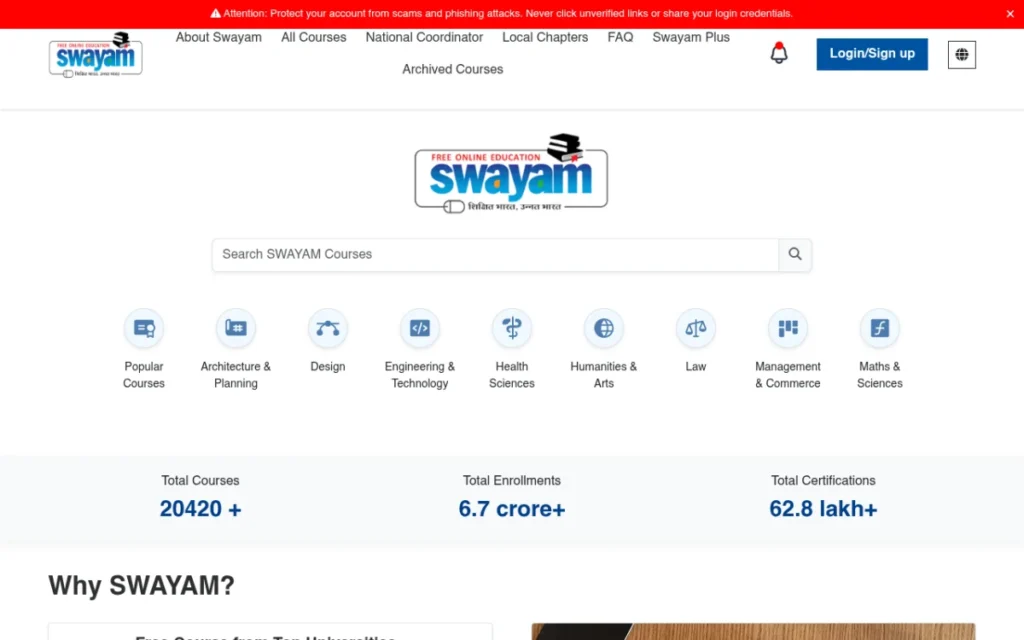
Quick answer: SWAYAM stands for Study Webs of Active-learning for Young Aspiring Minds. It is a free government MOOC platform with 20,420+ courses, 6.7 crore+ enrolments and 62.8 lakh+ certifications, according to its homepage. Learning is free; certificates need a proctored exam, such as ₹750 per course for IIM Bangalore’s management courses.
Facts on this page were checked on swayam.gov.in and partner sites on 5 November 2026. Figures on the portal update continuously.
Table of Contents
SWAYAM Full Form and Meaning
The SWAYAM FAQ gives the full form as Study Webs of Active-learning for Young Aspiring Minds. The word swayam also means “self” in Hindi and Sanskrit, which fits a platform built for self-driven learning. The footer of every SWAYAM page reads “Initiative by: Ministry of Education (Govt of India)”.
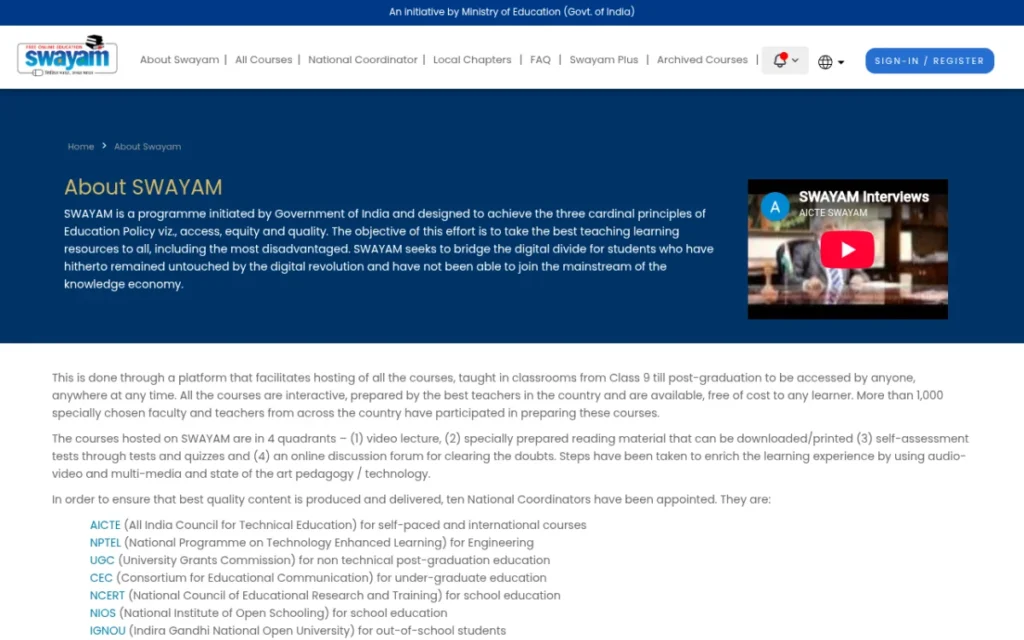
According to the About SWAYAM page, the programme is designed to achieve the three cardinal principles of education policy: access, equity and quality. Its stated aim is to bring the best teaching and learning resources to everyone, including students who have been left out of the digital revolution.
What Is SWAYAM Used For?
What is SWAYAM used for in everyday life? Indian learners use the SWAYAM portal in five main ways:
- To earn credits: college students take approved SWAYAM courses and transfer the credits to their degree.
- To prepare for exams and interviews: students revise core subjects such as data structures, economics or accounting from top teachers.
- To upskill for work: professionals take free courses in management, analytics, programming or communication.
- To support school learning: students in Classes 9 to 12 use NCERT and NIOS courses on the SWAYAM portal.
- To explore a new field: learners try a subject before committing to a paid degree or certificate.
The common thread is cost: because learning on the SWAYAM portal is free, the only decision with money attached is whether to sit the exam for a certificate.
SWAYAM full form in Hindi and meaning
The SWAYAM full form, Study Webs of Active-learning for Young Aspiring Minds, is an English acronym, but the word itself is Hindi: स्वयं (swayam) means “self”. The name signals the idea behind the portal: learning by yourself, at your own pace, with free access to the best teachers in India.
Who Runs SWAYAM?
SWAYAM is a Government of India programme under the Ministry of Education. The platform itself was developed by the Ministry of Education and NPTEL at IIT Madras, with help from Google and Persistent Systems, according to the About page.
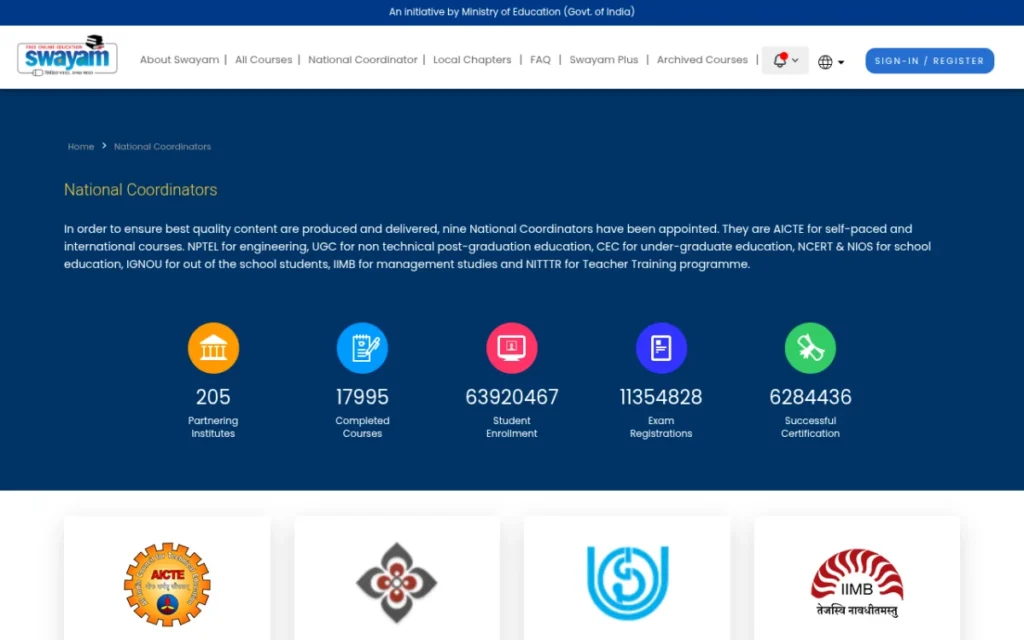
Course content comes through National Coordinators, each responsible for one segment of education. The National Coordinators page lists nine:
| National Coordinator | Courses it is responsible for |
|---|---|
| AICTE (All India Council for Technical Education) | Self-paced and international courses |
| NPTEL (IITs and IISc) | Engineering |
| UGC (University Grants Commission) | Non-technical postgraduate education |
| CEC (Consortium for Educational Communication) | Undergraduate education |
| NCERT | School education |
| NIOS (National Institute of Open Schooling) | School education |
| IGNOU | Out-of-school students |
| IIM Bangalore | Management studies |
| NITTTR | Teacher training |
The About page lists a tenth, INI, for non-technical courses, while the National Coordinators page and the FAQ refer to nine. The difference does not affect learners: you choose a course, and its page tells you which coordinator runs it.
SWAYAM in Numbers
SWAYAM is one of the largest online learning platforms in India. Its pages show these figures as of November 2026:
| Measure | Figure | Where it appears |
|---|---|---|
| Total courses | 20,420+ | swayam.gov.in homepage |
| Total enrolments | 6.7 crore+ | swayam.gov.in homepage |
| Total certifications | 62.8 lakh+ | swayam.gov.in homepage |
| Partnering institutes | 205 | National Coordinators page |
| Exam registrations | 1,13,54,828 | National Coordinators page |
| Successful certifications | 62,84,436 | National Coordinators page |
The About page adds that more than 1,000 specially chosen faculty and teachers from across the country have taken part in preparing SWAYAM courses.
How SWAYAM Courses Work
Every SWAYAM course is built from four parts, which the About page calls quadrants:
- Video lectures recorded by the course teacher.
- Reading material that you can download or print.
- Self-assessment through tests and quizzes, usually set as weekly assignments.
- An online discussion forum for clearing doubts with teachers and fellow learners.
Most courses follow a semester calendar, with a start date, weekly modules and a final exam. You cannot enrol in a scheduled course after it has started, but self-paced courses have no deadline. Self-paced courses, however, do not lead to a certificate.
Is SWAYAM Free?
Yes. The About page states that courses on SWAYAM “are available free of cost to the learners”. You can register, watch every lecture, read the material, attempt assignments and use the forum without paying anything.
You pay only if you want a certificate. Certification requires registering for a proctored exam, held in person at a designated centre, for a fee set by the course’s National Coordinator. Two examples: IIM Bangalore’s SWAYAM page states a fee of ₹750 per course, and NPTEL charged ₹1,000 per exam for its January 2026 exam cycle when paid before the deadline. Our guide to SWAYAM course fees covers exam costs in detail.
How SWAYAM Certificates Work
To earn a SWAYAM certificate, the FAQ lists four steps: join the course, submit the weekly assignments, register and pay for the exam, and write the in-person proctored exam at a centre. The certificate is issued by the course’s National Coordinator after results are declared.
Key rules from the SWAYAM FAQ:
- Exams are taken only at designated exam centres; you choose three preferred cities when registering.
- There is no negative marking, and no rechecking or re-evaluation.
- A retest is not held under any circumstances.
- Pass criteria vary by course and are shown on each course page.
For NPTEL courses, the NPTEL FAQ states that you pass only if your average assignment score is at least 40 out of 100 and your final exam score is at least 40 out of 100, with assignments worth 25% and the exam 75% of the final mark.
Can SWAYAM Credits Count Towards Your Degree?
Often, yes. SWAYAM says its homepage lets you “earn university credits and get them transferred to your degree”, and the About page notes that UGC issued a credit framework regulation for online learning courses through SWAYAM, allowing universities and colleges that approve credit transfer to use SWAYAM marks or certificates. Whether credits count for you depends on your own university’s rules, so check with your department or college coordinator before you enrol.
What You Can Study on the SWAYAM Portal
The SWAYAM portal groups its courses into nine browsable categories on the homepage, which gives a good sense of its range:
| Category on the SWAYAM portal | Example subjects |
|---|---|
| Popular Courses | The most-enrolled courses of the current semester |
| Engineering & Technology | Programming, data science, electronics, mechanical and civil engineering |
| Management & Commerce | Marketing, finance, operations and entrepreneurship (largely IIM Bangalore) |
| Humanities & Arts | Literature, history, sociology, psychology |
| Maths & Sciences | Mathematics, physics, chemistry, biology |
| Health Sciences | Public health, nutrition, health care basics |
| Law | Constitutional law, intellectual property, cyber law |
| Design | Design thinking and visual design |
| Architecture & Planning | Urban planning and architecture fundamentals |
Within each category, every course page shows the teacher, the institution, the duration in weeks, the start and end dates, the exam date and whether the course carries credit. That makes the SWAYAM portal easy to compare against paid platforms.
The SWAYAM Semester Calendar
To understand what SWAYAM is in practice, it helps to know its rhythm. Most courses run in two semesters a year, broadly January and July. A typical cycle looks like this:
- Enrolment opens a few weeks before the semester, and you join the courses you want for free.
- Weekly content is released, with an assignment due each week.
- Exam registration opens midway through the course; you fill in the form, upload a photo and pay the fee online. For the July 2026 semester, the SWAYAM homepage noted that exam registration was extended to 5 November 2026.
- Admit cards are emailed before the exam, naming your test centre.
- Results and certificates follow after the exam, issued by the course’s National Coordinator.
If you miss a course start date, look for the same course in the next semester; many popular SWAYAM courses repeat every year.
Tips to Get the Most From SWAYAM
- Pick courses that match your semester. If your university accepts SWAYAM credits, choose courses your department has approved before you enrol.
- Do every weekly assignment. For NPTEL courses they count for 25% of the final mark, and you need at least 40 out of 100 in assignments to pass.
- Register for the exam early. Deadlines are strict, and you choose your preferred exam cities on a first-come basis.
- Use the discussion forum. Teachers and teaching assistants answer questions there, which is often the fastest way to clear a doubt.
- Download the reading material. It helps you revise offline and before the exam.
What Is SWAYAM for Teachers?
For teachers, SWAYAM is both a learning platform and a teaching resource. NITTTR runs teacher-training courses as a National Coordinator, and many college teachers use SWAYAM lectures to blend online material into their own classes. Teachers can also take subject courses to refresh their knowledge or move into new areas, and certified completion can support professional development records where institutions recognise it.
SWAYAM vs NPTEL vs SWAYAM Plus vs SWAYAM Prabha
These names are often confused:
| Name | What it is |
|---|---|
| SWAYAM | The national MOOC platform for courses from Class 9 to postgraduate level |
| NPTEL | The IIT and IISc programme that acts as SWAYAM’s National Coordinator for engineering, with its own portal at nptel.ac.in |
| SWAYAM Plus | A separate SWAYAM initiative linked from the main menu, focused on industry-relevant, employability courses |
| SWAYAM Prabha | A separate initiative that broadcasts educational content on DTH television channels |
| Archived courses | Past SWAYAM courses kept available for reference, linked from the main menu |
In short, NPTEL courses are SWAYAM courses for engineering and technology, while SWAYAM covers every level and subject.
Who Should Use the SWAYAM Portal?
- College students who want to learn beyond their syllabus, prepare for exams, or earn transferable credits.
- School students using NCERT and NIOS courses for Classes 9 to 12.
- Working professionals who want free, university-level courses in management, engineering or computing.
- Teachers taking NITTTR teacher-training courses or using SWAYAM content in class.
- Anyone who wants to learn from India’s top institutions at no cost.
SWAYAM: Pros and Cons
Strengths:
- Free to learn, with content from IITs, IIM Bangalore, IGNOU, NCERT and other national institutions.
- Government-backed certificates and possible university credit transfer.
- A huge catalogue spanning engineering, management, humanities, law, health sciences, design and school subjects.
- An official mobile app on Google Play for learning on the phone.
Limitations:
- Certificates need an in-person exam at a centre, which means travel for some learners.
- Scheduled courses cannot be joined after they start; plan around the semester calendar.
- Course quality and workload vary by teacher and coordinator.
- Self-paced courses do not give certificates.
How to Start Learning on SWAYAM
Go to swayam.gov.in, click Login/Sign up, and register with your name and email, or sign in with a Google or Microsoft account. Then search or browse the categories, open a course and click enrol. Our step-by-step SWAYAM registration guide walks through account creation, course enrolment and exam registration, and our SWAYAM courses guide explains how to find the right course.
If you are comparing free options more broadly, see our guides to free online courses with certificates in India and free AI courses. Learnmango also lists verified online coaches across many niches if you want guided, paid learning.
Frequently Asked Questions
What is SWAYAM?
SWAYAM is the Government of India’s free online learning platform, an initiative of the Ministry of Education. It offers courses from Class 9 to postgraduate level from institutions such as the IITs, IIM Bangalore, IGNOU and NCERT, free to learn, with optional paid exams for certificates.
What is the full form of SWAYAM?
SWAYAM stands for Study Webs of Active-learning for Young Aspiring Minds, according to the official SWAYAM FAQ.
Is SWAYAM free?
Yes. All SWAYAM courses are free to learn. You pay only if you want a certificate, which requires a proctored exam with a fee set by the course’s National Coordinator, such as ₹750 per course for IIM Bangalore courses.
Who runs SWAYAM?
SWAYAM is run by the Ministry of Education, Government of India. The platform was developed by the Ministry and NPTEL at IIT Madras, with help from Google and Persistent Systems, and content is managed by National Coordinators such as AICTE, NPTEL, UGC, CEC, NCERT, NIOS, IGNOU, IIM Bangalore and NITTTR.
Is a SWAYAM certificate valid?
SWAYAM certificates are issued by the course’s National Coordinator after you pass the proctored exam. SWAYAM says its courses are recognised by the Government of India and participating institutions, though recognition can vary, and universities may accept them for credit transfer under UGC’s framework.
What is the difference between SWAYAM and NPTEL?
SWAYAM is the national platform for all subjects and levels. NPTEL, run by the IITs and IISc, is SWAYAM’s National Coordinator for engineering and technology courses and also has its own portal at nptel.ac.in.
How many courses are on SWAYAM?
The SWAYAM homepage shows 20,420+ courses, with 6.7 crore+ enrolments and 62.8 lakh+ certifications, as of November 2026.
Can I get credits from SWAYAM courses?
Often, yes. SWAYAM courses can be used for credit transfer by universities and colleges that approve it under UGC’s credit framework for SWAYAM courses. Check with your own university before enrolling.
Is there a SWAYAM app?
Yes. The SWAYAM homepage links to an official app on Google Play, so you can learn on your phone.
Can school students use SWAYAM?
Yes. NCERT and NIOS are SWAYAM’s National Coordinators for school education, and SWAYAM says it offers courses from Class 9 to postgraduate level.
What is SWAYAM portal used for?
The SWAYAM portal is used to take free online courses from Class 9 to postgraduate level, earn credits that some universities accept towards a degree, prepare for exams, and gain certificates by passing proctored exams for a small fee.
What is the SWAYAM full form in Hindi?
The SWAYAM full form is Study Webs of Active-learning for Young Aspiring Minds. The word swayam in Hindi means self, reflecting self-paced learning on the SWAYAM portal.
Key Takeaways
- SWAYAM (Study Webs of Active-learning for Young Aspiring Minds) is the Ministry of Education’s free online course platform.
- It offers 20,420+ courses from Class 9 to postgraduate level through nine National Coordinators, including NPTEL, IIM Bangalore, IGNOU and NCERT.
- Learning is free; certificates need an in-person proctored exam with a fee, such as ₹750 for IIM Bangalore courses.
- Universities may accept SWAYAM credits under UGC’s framework; check your own institution’s rules.
- NPTEL, SWAYAM Plus and SWAYAM Prabha are related but different initiatives.
Facts were checked on swayam.gov.in and nptel.ac.in on 5 November 2026. Learnmango is an independent guide and is not affiliated with SWAYAM or the Ministry of Education.